
Hello learner, welcome back to our new post in which we learn about main components of hydro power plant with their proper function.
What is hydro power plant?
A hydro power plant is a type of power generation plant which is used conventional mode of operation for production of electrical power.

It uses hydraulic energy for producing mechanical energy and due to this mechanical energy alternator converting into electrical power as an output.
The power generation for hydro power plant is cheaper and environmental friendly because it's doesn't emit any type of pollution either in water or in air.
Approximately, about 19% of the total energy produces by the hydropower ( water power). Currently, India has total 197 hydroelectric Power plant.
Hydro power is an renewable sources of energy, due to this is widely used all over the world for meeting their power requirements.
Working of hydroelectric power plant:-
Water is initially stored in reservoir having stored potential energy in it, when the valves and gate are open of the penstock due to the gravitational pull, water Aquarius kinetic energy.
By using kinetic energy of water, hydraulic turbines rotates which leads to create mechanical energy. Due to coupling between the hydraulic turbines and alternator, an alternator shaft rotates and produce electrical energy as an output.
Block diagram of hydroelectric Power Power:-
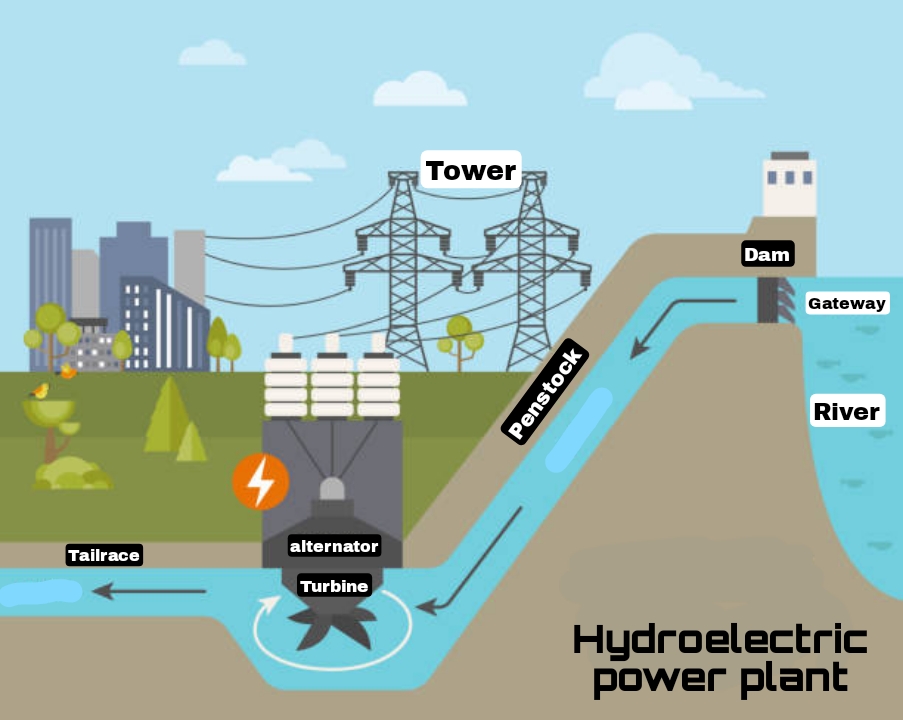
Components of hydroelectric Power plant
The major components of hydroelectric Power plant are as follows :-
1. Reservoir
2. Dam
3. Fore bay
4. Spillway
5. Penstock
6. Surge tank
7. Hydraulic turbines
8. Power house
9. Draft tube
10. Tailrace
Let’s explain each component in detail.
1. Reservoir
A reservoir is a storing area around a dam which store bulk amount of water in it. It is made by artificial or natural process. The Store water is used for produce electricity and also for irrigation around the catchment area.
2. Dam

A dam is barrier wall which restrict the flow of surface water and create water head. Dam are built from the concrete or stone masonry, earth or rock fill.
It is concentrated on the hill/mountain area. The strength of dam is designed by proper studying of hydrograph of water around it.
3. Fore bay
A fore bay is a temporarily stored / regulating reservoir to stored water during the light load condition.
Fore bay is generally used in hydroelectric power plant which are situated away from the main reservoir. The available of water in the fore bay is totally based on the water demand in that area.
4. Spillway

It is concentrated on the concrete piers on the top of the dam. It's provide with metal gate for the controlling purpose of water in the storing reservoir.
Some time during the flood condition overflow of water arrives on the reservoir, which may cause some disaster condition if not been taken carefully.
For the protection of the dam discharging the overflow water from the reservoir through spillway.
5. Penstock

A penstock are open conduit or closed conduit which is used to carry water from the catchment area to the turbine house for the production of electrical energy.
It is made up of reinforced concrete or steel. Reinforced concrete penstock are generally used for low head because as length increase which causes greater pressure which deterioration of concrete pipe.
The steel penstock can be designed for any head, as the head increase then the thickness of steel pipe increase.
6. Surge tank
A surge tank is cylinder tank / chamber which is placed near the beginning of the penstock. It is used to control the water pressure in the penstock during the sudden closing gate of turbine house.
Open conduit penstock doesn't need any protection ( surge tank ) but for the closed conduit penstock need protection for controlling the abnormal condition arrives on the conduit, which lead burst the conduit.
Whenever load reduced suddenly then turbine gate closed by the governor for the protection of hydraulic energy.
Due to sudden closing of turbine gate create high pressure on the penstock which destroyed penstock.
To avoid this phenomenon we generally used surge tank on the closed conduit type penstock.
7. Hydraulic turbines
Hydraulic turbines are used to convert the energy of Falling of water into the mechanical energy.
In another word, the elements which converts kinetic energy of water is convert into the mechanical energy is hydraulic turbines.
There are two types water turbine are :-
- Impulse turbine
- Reaction turbine
1. Impulse turbine
An impulse turbine are used for high heads hydroelectric power plant. In this entries pressure of water is projected on turbine due to this entries pressure converted into the mechanical energy. Thus, Impulse turbine also known as velocity turbine.

Impulse turbine used tangential flow direction forced for the rotation. The example of this turbine is the pelton wheel.
2. Reaction turbine
A reaction turbine are used for low and medium head type hydroelectric power plant. In the reaction turbine, water entries on the runner blades with pressure and partly velocity head. Thus, reaction turbine also known as pressure turbine.
There are two types reaction turbine are :-
A. Kaplan turbine:-
A Kaplan turbine are used for low head and large quantity of water flow. It's used for axial flow of direction for rotation.
B. Francis turbine:-

A Francis turbine are used for medium head and large quantity of water flow. It's used for combined of radial and axial flow.
Water flow radially inward to regulating gates all around the sides, these causes a reaction force which drive the turbine.
8. Power house

A power house is a building in which in the bottom area turbine house are connected with penstock, above the turbine alternator are placed. An alternator convert mechanical energy into the electrical energy as an output.
Through the help of conductor electrical power is transferred to the step up transformer which step up the voltage level to high value and finally, transferred to grid.
9. Draft tube
After the rotation of turbine the outlet of water from the turbine house through the draft tube. Draft tube is connector between the turbine house to the tailrace.
A draft tube gradually increase diameter from the low the output pressure and velocity of the water.
10. Tailrace
A tailrace is a channel or conduit through which water flows away from a hydroelectric power plant after it has passed through the turbines.

The water is typically returned to a river, stream, or other body of water downstream of the power plant. The tailrace serves to dissipate the kinetic energy of the water and return it to the natural watercourse.
ALSO READ THIS :-
Types of hydro power plant:-
There are three types of hydro power plant classified are as follows:-
- Run-of-river hydropower
- Storage hydropower
- Pumped storage hydropower
Run-of-river hydropower:-
A flow of water through the penstock or a canal to rotate turbine. These type of hydro plant doesn't have any storing elements in it. It is totally depends on the flow of water thus, it is used as a base load power house.
Storage hydropower:-
These type of power house users storage like dam or reservoir for production of large amount of electrical power.
Storage hydropower plant are of higher rating and its has capacity to run full day thus, its also used for base load power plant.
Pumped storage hydropower:-
A pumped storage power plant is a peak load power plant, which works along with the base load power plant and responsive to the load.
It has two mode of options:-
- During peak load condition, it's operate like generator, thus its flows water down to rotate turbine to produce electricity.
- During off peak load condition, it's operate like motor, this it's pull back water from lower reservoir to the upper reservoir.
Advantages of hydro power plant
- There is no any cost required for fuel of hydroelectric power plant (water).
- It is work on renewable sources of energy thus, it is Reliable.
- There is no any by product emitted or produce by the power plant.
- No any stand by losses in this power plant.
- High efficiency ( approximately 85%).
- It has longer life and robust.
- As compared to other power plant, it is simple in construction and required less maintenance.
- This power plant serve many purposes like help in irrigation and control floods.
Disadvantages of hydro power plant
- It required high capital cost for construction.
- It required huge amount land area for dam construction.
- High skilled labour required for build power plant.
- High transmission line cost required for these power plant because it is located in hilly areas.
Frequently Asked Questions - FAQs
Which is the largest power plant in India?
The Koyna hydroelectric power plant in Maharashtra on Krishna river is the largest hydroelectric power station having installed capacity of around 1,960 MW.
Which is the largest Hydropower plant in the world?
The Three Gorges in China on Yang-Yang river is the largest power station in the world having installed capacity of around 22,500 MW.
Why hydropower is called renewable source of energy?
Hydropower is called renewable source of energy because it use water for generation of electrical energy and doesn't produce any pollution in the environment.
How much total hydroelectric power plant in India?
Currently, India has 197 hydroelectric power plant.

this blog very importantthank for, writing.
ReplyDelete